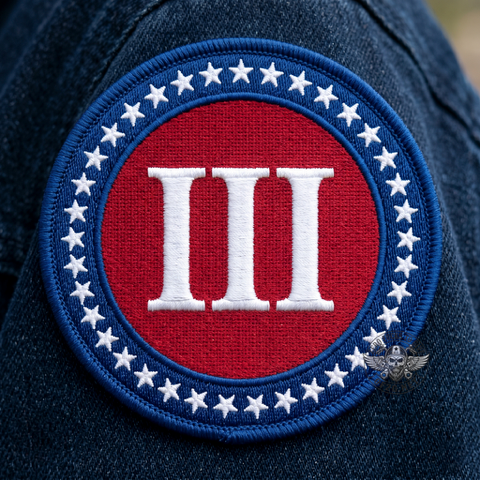
The “III%” (or Three Percenter) symbol proclaimed by many modern patriot and militia groups has a backstory rooted in a specific interpretation of American history, mixed with modern political ideologies. Here is the breakdown of where the movement comes from, what it stands for, and the history behind the math.
THE CORE CLAIM
The name “Three Percenter” derives from a popular, though historically disputed, claim that only 3% of American colonists took up arms and actively fought against the British during the American Revolution.
Those who identify as Three Percenters view themselves as the modern-day ideological descendants of that original vanguard. They believe that, just as a small, dedicated fraction of the population was able to overthrow a tyrannical British government, a small force of armed and dedicated individuals today can protect Constitutional rights and liberties against perceived government overreach.
THE ORIGIN STORY
The movement itself isn’t a remnant from the 1700s; it is a relatively modern creation. • The Founder: The concept was popularized in 2008 by the late Mike Vanderboegh, an anti-government activist and gun rights advocate, who published the movement’s doctrine on his blog, Sipsey Street Irregulars. • The Catalyst: The movement began coalescing largely as a reaction to the 2008 election of President Barack Obama. Vanderboegh and his followers feared that the new administration would lead to stricter federal gun control laws and increased government interference in citizens’ lives. Vanderboegh framed the “Three Percent” as gun owners who would simply refuse to comply with future gun control acts, stating, “We will not disarm.”
THE HISTORICAL REALITY
While the idea of a tiny, 3% resistance overthrowing an empire is a powerful and romantic narrative, historians generally agree that the math is a misconception. • The Numbers: The population of the colonies during the war was roughly 2.5 million. Three percent of that would be about 75,000 people. While 75,000 might roughly align with the number of active military personnel at certain low points in the war, it drastically underestimates the broader resistance. • The John Adams Myth: The idea that the country was neatly divided into thirds (one-third patriot, one-third loyalist, one-third neutral) is a long-standing myth based on a misreading of an 1815 letter by John Adams. Adams was actually referring to American attitudes toward the French Revolution at the time, not the American Revolution. • The Broader Resistance: Far more than 3% of the population participated in the war effort through local militias, supply networks, boycotts, and political support.
IDEOLOGY AND SYMBOLISM
Today, the Three Percenters exist as a decentralized, right-wing, anti-government militia movement. Because it is decentralized, there is no single leader or official roster, meaning beliefs and actions can vary widely from one local chapter to another. However, a few common threads tie them together: • Second Amendment Absolutism: A fierce defense of gun ownership, viewing firearms as the ultimate and necessary check against a tyrannical government. • Anti-Government Stance: A fundamental belief that the U.S. federal government frequently oversteps its Constitutional limits and that citizens must be prepared to resist. • Symbolism: Adherents often use the Roman numeral III or 3%, sometimes superimposed over a 13-star Betsy Ross flag (often referred to as the Nyberg flag). You might also see members flashing the “OK” hand sign with three fingers extended as a visual signal of their affiliation.
Ultimately, the III% is less about historically accurate census data from the 1770s and more about a modern political identity—a way for individuals to signal that they view themselves as the last line of defense against government tyranny.
THE CORE CLAIM
The name “Three Percenter” derives from a popular, though historically disputed, claim that only 3% of American colonists took up arms and actively fought against the British during the American Revolution.
Those who identify as Three Percenters view themselves as the modern-day ideological descendants of that original vanguard. They believe that, just as a small, dedicated fraction of the population was able to overthrow a tyrannical British government, a small force of armed and dedicated individuals today can protect Constitutional rights and liberties against perceived government overreach.
THE ORIGIN STORY
The movement itself isn’t a remnant from the 1700s; it is a relatively modern creation. • The Founder: The concept was popularized in 2008 by the late Mike Vanderboegh, an anti-government activist and gun rights advocate, who published the movement’s doctrine on his blog, Sipsey Street Irregulars. • The Catalyst: The movement began coalescing largely as a reaction to the 2008 election of President Barack Obama. Vanderboegh and his followers feared that the new administration would lead to stricter federal gun control laws and increased government interference in citizens’ lives. Vanderboegh framed the “Three Percent” as gun owners who would simply refuse to comply with future gun control acts, stating, “We will not disarm.”
THE HISTORICAL REALITY
While the idea of a tiny, 3% resistance overthrowing an empire is a powerful and romantic narrative, historians generally agree that the math is a misconception. • The Numbers: The population of the colonies during the war was roughly 2.5 million. Three percent of that would be about 75,000 people. While 75,000 might roughly align with the number of active military personnel at certain low points in the war, it drastically underestimates the broader resistance. • The John Adams Myth: The idea that the country was neatly divided into thirds (one-third patriot, one-third loyalist, one-third neutral) is a long-standing myth based on a misreading of an 1815 letter by John Adams. Adams was actually referring to American attitudes toward the French Revolution at the time, not the American Revolution. • The Broader Resistance: Far more than 3% of the population participated in the war effort through local militias, supply networks, boycotts, and political support.
IDEOLOGY AND SYMBOLISM
Today, the Three Percenters exist as a decentralized, right-wing, anti-government militia movement. Because it is decentralized, there is no single leader or official roster, meaning beliefs and actions can vary widely from one local chapter to another. However, a few common threads tie them together: • Second Amendment Absolutism: A fierce defense of gun ownership, viewing firearms as the ultimate and necessary check against a tyrannical government. • Anti-Government Stance: A fundamental belief that the U.S. federal government frequently oversteps its Constitutional limits and that citizens must be prepared to resist. • Symbolism: Adherents often use the Roman numeral III or 3%, sometimes superimposed over a 13-star Betsy Ross flag (often referred to as the Nyberg flag). You might also see members flashing the “OK” hand sign with three fingers extended as a visual signal of their affiliation.
Ultimately, the III% is less about historically accurate census data from the 1770s and more about a modern political identity—a way for individuals to signal that they view themselves as the last line of defense against government tyranny.